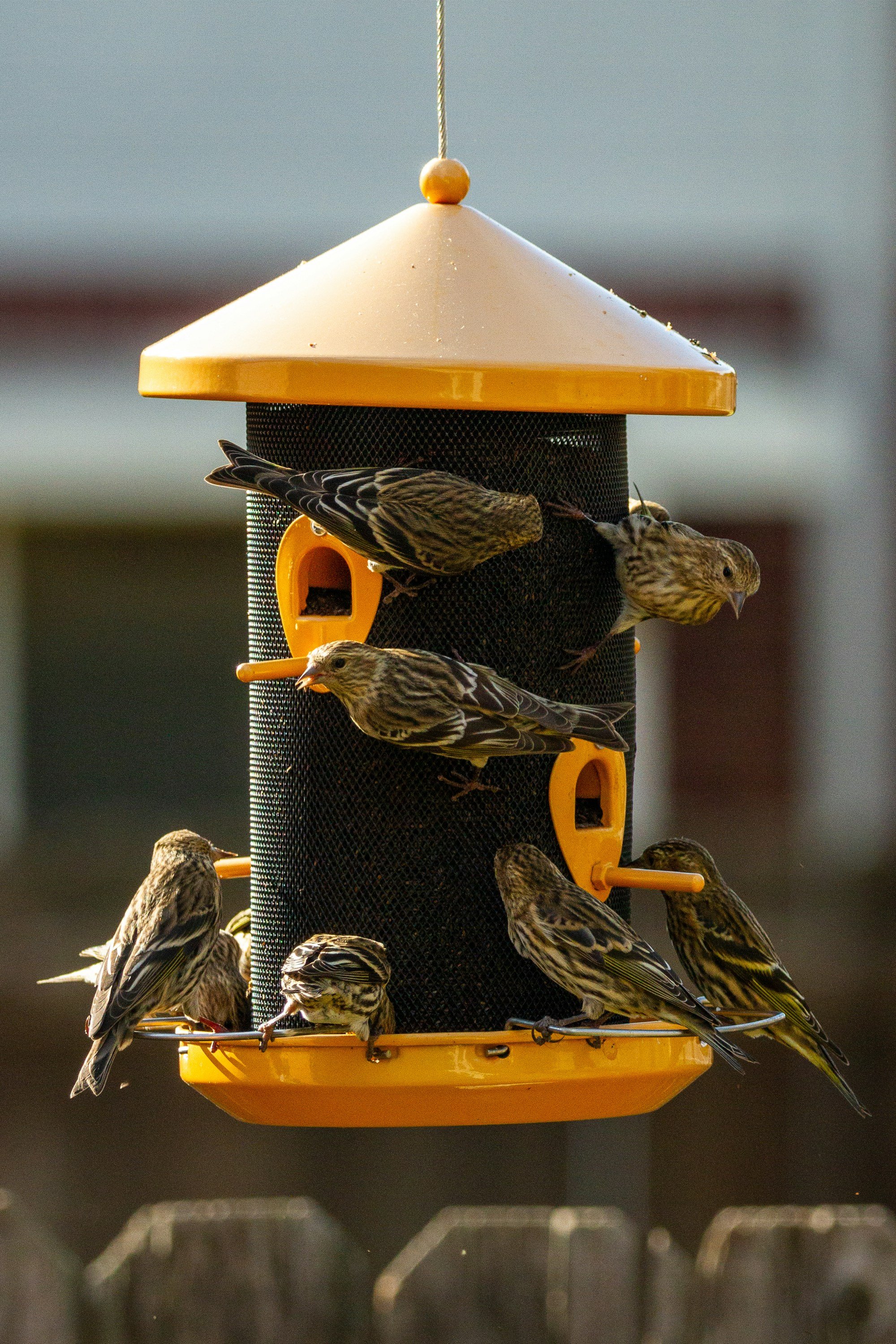

If you only buy one bag, make it black-oil sunflower seed. Put it in the tube feeder or a hopper and you’ll cover more of the common feeder birds than any other single food will. Then add three small extras for the birds it misses: white proso millet scattered low for juncos and sparrows, nyjer in its own feeder for goldfinches, and a suet cage for woodpeckers. Skip the cheap mixes padded out with milo and wheat. Most birds pick around them, and you end up paying for the pile under the feeder.
That’s the short answer. The long one is a bit more interesting, because two of the best sources on this don’t quite agree, and the spots where they part ways are worth knowing before you buy anything.
I’m Corinne, and everything below comes from those two sources, which I read again this week. One is the feeding guide from Project FeederWatch, the November-to-April bird survey the Cornell Lab of Ornithology and Birds Canada run with volunteers. The other is a careful U.S. Fish and Wildlife Service study, Relative Attractiveness of Different Foods at Wild Bird Feeders, by Aelred Geis at the Patuxent Wildlife Research Center in Maryland (published in 1980). Geis set out feeding tables with a separate box for each food, moved the boxes around so no seed got the best spot, and counted which box each bird chose. The study is 46 years old. But honestly, I think it still reads like it was written for anyone standing in a feed store aisle.
Black-Oil Sunflower: The Seed Most Birds Take

FeederWatch calls black-oil sunflower the most common seed offered at feeders in North America. It’s small and high in energy, and the shell is thin enough for a chickadee to crack. Their list of birds that love it starts with cardinals and chickadees, then finches and sparrows (woodpeckers eat some too).
The 1980 counts make the same case with numbers. Geis compared the small black oil-type seed with the bigger black-striped sunflower seed, and the oil type won for most of the birds he counted:
- Carolina chickadees came to it 3.5 times as often as to striped sunflower.
- House finches gave it more than twice the visits. They ate red millet and thistle only 20 to 30% as often as the striped seed.
- Purple finches visited it 4 times as often.
- Evening grosbeaks made 48% more visits to it.
- Mourning doves rated it their top food, even though they mostly ignored the other sunflower types. Striped seed got less than a fourth as many dove visits.
Cardinals ranked it first too, with striped sunflower second. So if your bag says “striped” and the feeder’s quiet, that’s the first thing I’d change.
Hulled sunflower, the “no mess” kind, is the same seed out of its shell. FeederWatch says any bird that eats sunflower will take it, and many prefer it. It spoils faster once it’s wet, though, so I’d keep it for a feeder with a roof and buy it in smaller bags.
Millet on the Ground for Juncos and Sparrows

Some of the birds you most want in winter barely use a hanging feeder at all. Song sparrows, fox sparrows and towhees rarely land on one, FeederWatch says, but they’ll happily eat what’s on the ground below it.
For them the seed is white proso millet. Geis called it the best seed in the study for drawing small seed-eating birds. Dark-eyed juncos took red proso and white proso first. Song sparrows liked white proso about twice as much as red. Tree sparrows were one of the few birds that leaned slightly toward the red, which is weirdly specific, but there it is.
A handful on the ground or on a low platform is enough. That’s FeederWatch’s advice too (a handful sprinkled for the juncos and sparrows), and I’d keep it to what gets eaten in a day. Spilled grain draws rodents.
One honest trade-off. In the same counts, white proso millet was the favorite food of the brown-headed cowbird, and house sparrows preferred it to most other foods. If those two run your yard, I’d cut the millet back and see who’s left.
Nyjer for Goldfinches, Served on Its Own

Nyjer is the tiny black seed sold as “thistle.” Turns out it isn’t thistle at all. FeederWatch says it comes from Guizotia abyssinica, a plant native to Africa, and it’s heat-treated before it’s imported so it won’t sprout under your feeder.
It’s a finch seed. American goldfinches, pine siskins and common redpolls are the birds it’s for. In the 1980 counts, goldfinches went for hulled sunflower and thistle, and for oil-type sunflower too, far more than for striped sunflower. Millet didn’t interest them.
Two things make nyjer work. It needs its own feeder with very small ports, or the seed pours straight out onto the ground. And it goes in by itself, not mixed into anything, which is FeederWatch’s advice to cut waste. A nyjer sock or a finch tube hung beside the tube feeder is the usual setup, and to me it’s the easiest of the four to get right.
Peanuts and Suet: Where the Sources Split

Here’s where the two sources part ways, and it’s worth knowing before you buy a mix with peanuts in it.
FeederWatch lists peanuts as a food many birds love. Jays carry off several at once to hide them, and smaller birds like chickadees and titmice do better with shelled ones. Raw or roasted is fine, but never salted, coated or flavored, and moldy peanuts go in the trash.
Geis saw the same appetite and drew a different conclusion. In his counts, whole peanut kernels were the blue jay’s top food by a wide margin, and black-oil sunflower got less than a fifth of the jay visits striped sunflower did. His advice, written right into the report: if you don’t want blue jays, leave the peanuts out and use the small oil-type sunflower instead of the striped kind. Tufted titmice also put peanut kernels first. Starlings, which took few foods at all, went straight for peanut hearts and hulled oats.
So the sources agree on what peanuts attract. The thing is, they differ on whether that’s a good thing. I can see both sides, and I’d say that part is up to you and your yard.
Suet is for the insect-eaters. FeederWatch says most of it is beef kidney fat, sold plain or pressed into cakes with seed and fruit, and it can go rancid in hot weather unless it’s been processed for summer. The suet cage matters as much as the suet. A cage you can only reach from below lets woodpeckers and nuthatches hang upside down to eat, and it keeps most starlings off. That’s pretty much the whole trick.
Safflower: The Cardinal Seed Nobody Counted in 1980

Safflower looks like a small white sunflower seed, and bags of it are sold as the cardinal seed. FeederWatch agrees it draws cardinals and other big-billed birds. Then it adds a line I like for its honesty: in their experience, most birds prefer sunflower over safflower.
Geis didn’t test safflower at all, so the 1980 counts can’t settle it either way. Where that leaves me is pretty plain. Safflower makes sense as a second feeder for cardinals, not as the only seed in the yard. If you try it, give the birds 2 weeks or so before you judge, and keep the sunflower feeder up beside it so you can compare.
The Fillers Birds Leave Behind

The study’s first finding is the one that saves the most money. In the abstract, before any of the bird-by-bird detail, Geis lists the foods that were relatively unattractive: fine cracked corn, wheat, sorghum (milo), hulled oats and rice. Those are exactly the cheap grains that bulk up a budget mix.
FeederWatch says the same about milo, the round reddish grain. It’s often a major part of inexpensive mixes, most birds don’t favor it, and it tends to go to waste. They add a regional note that matters: western birds eat milo more than eastern birds do, so the advice to avoid milo-heavy mixes is strongest in the East. The 1980 study was run in Maryland, which fits.
Canary seed is a smaller case of the same thing. It shows up in small amounts in some mixes, and in 1980 it cost about 70% more than white proso millet. Sparrows and doves used it, finches a little, but no bird in the study found it nearly as attractive as the millet. Geis saw little point in adding it to mixes and none in serving it alone. I’d leave it out too.
Cracked corn is the one where the sources lean different ways. Geis found fine cracked corn unattractive overall, though juncos and tree sparrows used it. FeederWatch says cracked corn brings doves and quail, plus sparrows, and suggests mixing it with millet on the ground or a platform. Both can be true. Corn is a ground-bird food, not a feeder food, and a scoop on the ground is plenty.
Read the ingredient list on the bag, not the picture on the front. If milo or wheat comes first, most of what you’re paying for will end up under the feeder. I mean, that’s the whole problem with a cheap mix in one sentence.
One Yard, Four Feeders: A Simple Setup
Put together, the advice turns into a setup you can build one piece at a time:
- The tube feeder or a hopper with black-oil sunflower seed. Start here.
- A handful of white proso millet on the ground or a low tray, for juncos and sparrows.
- A small-port finch feeder with nyjer and nothing else.
- A suet cage, open only at the bottom, for woodpeckers and nuthatches.
Hang them about 10 ft from a tree or shrub. That’s FeederWatch’s compromise: close enough to cover that birds can wait their turn, far enough that squirrels and cats don’t get an easy launch point. Squirrels can jump to a feeder closer than that. A squirrel baffle helps too. On a pole it goes below the feeder, and if squirrels drop in from above, FeederWatch suggests a tilting baffle at least 18 inches across, mounted over it.
Windows are the other risk near a feeder. If yours hangs close to the house, FeederWatch suggests marking the outside of the glass with dots or tape spaced no more than 2 inches apart, so birds see the window as a barrier.
And keep a clean feeder, which matters more than the seed. FeederWatch asks for seed and suet feeders to be scrubbed every 1 to 2 weeks with warm soapy water (more often in wet weather or heavy use) and dried fully before refilling. To disinfect, soak the cleaned parts for 10 minutes in one part bleach to nine parts water, then rinse well. They also suggest raking up the hulls and spilled seed below. Wear gloves for all of it. It’s a bit of a chore — genuinely worth it, though.
If a bird at your feeders looks sick (fluffed up and slow, or with crusty eyes), clean more often and think about taking the feeders down for a while. Don’t try to catch it. A sick or hurt wild bird is a call to the state wildlife agency or a wildlife rehabilitator, who are licensed to handle it.
I’ll keep adding to this as FeederWatch updates its guide. If your yard sees something the counts don’t explain (a bird that ignores the sunflower, say, or loves the milo), I’d genuinely like to know. It’s usually about where you live.